

What Is a SEER Rating, and What Does It Mean?
If you’ve ever shopped for a new air conditioner or had a conversation with an HVAC technician about replacing your system, you’ve probably heard the term SEER rating. It’s one of the most important numbers attached to any air conditioning unit, but it’s also one of the most misunderstood.
Cooper Mechanical Services explains what it means, why it matters, and how to use SEER ratings when making a purchase.
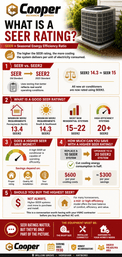
SEER (Seasonal Energy Efficiency Ratio) is an AC efficiency rating measuring how well an air conditioner cools your home relative to the energy it uses. Higher SEER ratings mean lower operating costs, but the right rating for your home depends on climate, usage, and equipment sizing. As of 2023, all new AC equipment is rated under the updated SEER2 standard.
SEER Rating Explained
SEER stands for Seasonal Energy Efficiency Ratio. It measures how efficiently an air conditioning system converts electricity into cooling over an entire cooling season. The higher the SEER rating, the more cooling the system delivers per unit of electricity consumed.
What Is SEER2?
In 2023, the U.S. Department of Energy updated the testing standards used to calculate efficiency ratings. The new standard is called SEER2, and it uses a testing protocol that better reflects real-world operating conditions.
SEER2 ratings are lower than the equivalent SEER rating for the same equipment, because the new test is more demanding. A unit rated SEER2 14.3 is equivalent to a traditional SEER 15 unit in terms of real-world efficiency.
All new air conditioning equipment sold in the United States is now rated under SEER2. If you’re comparing older quotes or older units to newer ones, make sure you’re comparing within the same rating system.
What Is a Good SEER Rating for ACs?
As of 2023, the minimum SEER2 requirements in the United States are:
- 13.4 SEER2 in the North (which includes Pennsylvania)
- 14.3 SEER2 in the South and Southwest
These are the legal minimums. They are not necessarily the best AC units for your home.
Most new residential systems fall between 15 and 22 SEER2. Energy-efficient air conditioners can reach 20+ SEER2.
Does a Higher SEER Rating Always Mean Lower Energy Bills?
A high SEER air conditioner means the system is capable of operating efficiently. Whether it delivers those savings depends on other factors:
- Proper sizing
- Quality AC installation
- Your climate
How Much Can You Save with a Higher SEER Rating?
The energy savings depend on how much you’re spending on cooling, your local electricity rates, and how often you run the system. Here’s a general comparison:
- If you replace a 10 SEER system with a 20 SEER2 system, you’re cutting your cooling energy consumption in half. In a home that spends $600 per year on air conditioning, that’s about $300 in annual savings.
Should You Buy the Highest SEER Rating Available?
Higher-SEER systems cost more to purchase and install. How long it takes for the energy savings to offset that premium depends on how much you run your system and what you pay for electricity.
For homeowners in the greater Philadelphia area who run their AC from late May through September, upgrading from a minimum-efficiency unit to a mid- or high-efficiency model makes financial sense. For a homeowner with a smaller home who runs their system infrequently, a mid-range system may offer better value.
This is a conversation worth having with your HVAC contractor before you buy the perfect AC unit.

FAQs
What is the minimum SEER rating I can buy in Pennsylvania?
As of 2023, the minimum efficiency standard for new air conditioners in Pennsylvania is 13.4 SEER2. Units below this standard can no longer be installed.
Is SEER2 the same as SEER?
No. SEER2 uses a more rigorous test method that reflects real-world conditions more accurately. SEER2 ratings are lower than SEER ratings for the same equipment.
Does a higher SEER rating mean better comfort?
Often, yes, but not because of the efficiency number itself. Higher SEER-rated systems use variable-speed or two-stage compressors, which run longer at lower capacity. This means more consistent temperatures, lower humidity levels, and quieter operation compared to single-stage systems that cycle on and off.
Does my SEER rating affect my home’s value?
Yes. Energy efficiency is a selling point for buyers, and a modern, high-efficiency HVAC system can be a meaningful factor in a home’s appeal and appraisal.
Talk to Cooper Mechanical Services About Your Next AC System
SEER ratings matter, but they’re only one part of the picture. The equipment has to be the right size, installed correctly, and matched to your home’s specific needs. That’s what we do at Cooper Mechanical Services.
We’ve been helping homeowners in Willow Grove, Horsham, Hatboro, and across the greater Philadelphia area make smart HVAC investments since 1930. Whether you’re replacing an aging system or trying to understand your options, we’ll give you straightforward answers and an honest recommendation. Call us today!