
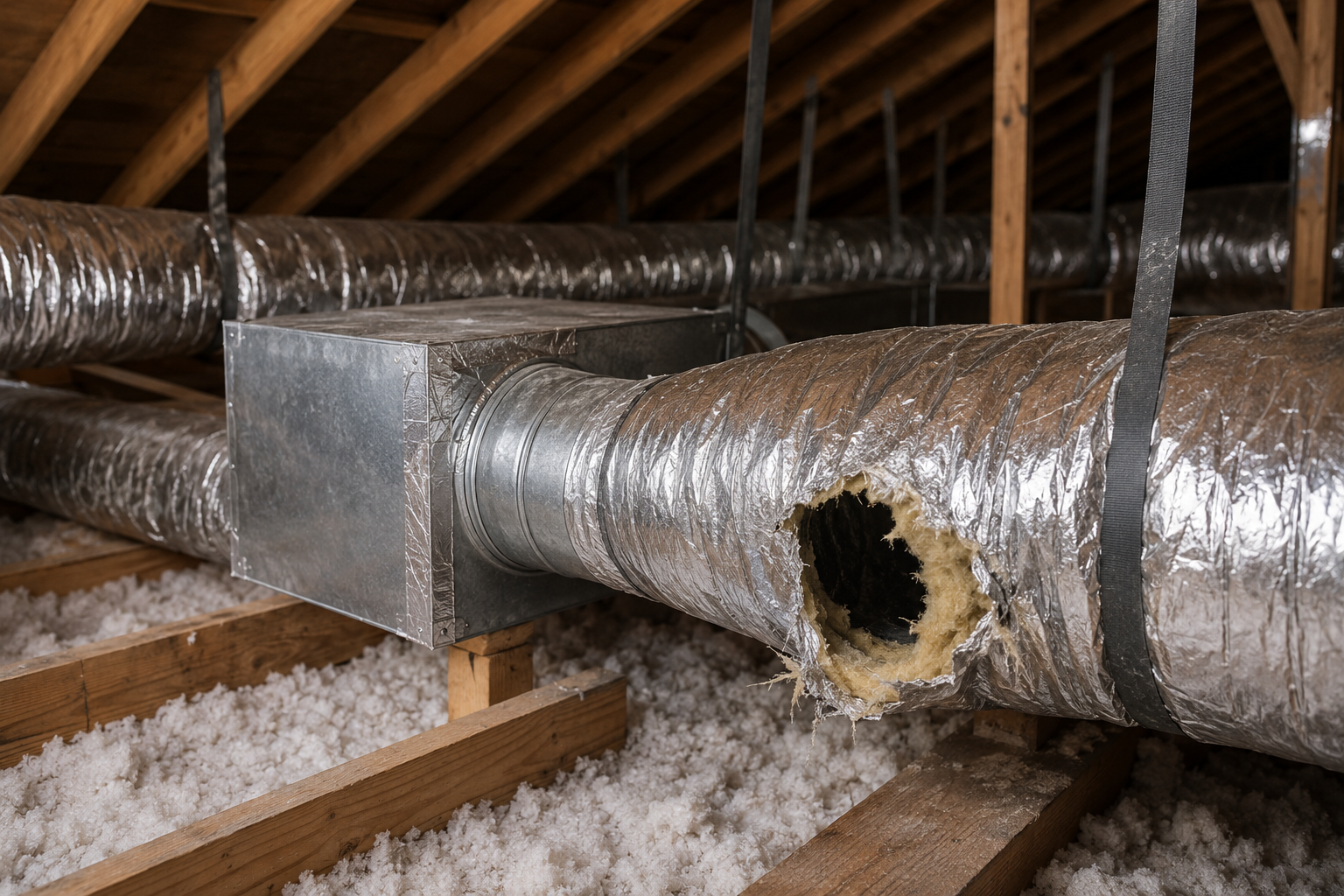
How HVAC Ductwork Problems Reduce Cooling Efficiency
Ducts are the delivery system for everything your HVAC equipment produces. When they leak, sag, or deteriorate, conditioned air never reaches the rooms it’s meant to cool.
HVAC ductwork problems are behind a significant portion of the efficiency and comfort complaints we diagnose at Cooper Mechanical Services. They’re also among the most overlooked, because ducts are in attics, crawl spaces, and inside walls where no one thinks to look.
Leaky or damaged ductwork wastes conditioned air before it reaches your living spaces, forces your AC to run longer, and creates uneven temperatures inside your home. Sealing and repairing ducts is one of the most cost-effective ways to improve cooling in an existing home.
What Happens When Ducts Leak
When supply ducts have gaps, holes, or disconnected sections, the air you’re paying to cool escapes into unconditioned spaces. The rooms you’re living in get less airflow than they need.
The system responds by running longer, but longer run times don’t fix the problem. Your energy bills go up, your home stays uncomfortable, and the extra run time adds wear to every component in the system. Air duct repair and duct leak repair are the only ways to stop the problem.
Common Symptoms of Leaky Ductwork
The most common leaky ductwork symptoms appear gradually, which is why many homeowners don’t connect them to their duct system until the problem has been building for months.
Uneven Temperatures Between Rooms
If some rooms are warmer than others, duct leaks or restrictions are a likely cause. Conditioned air is reaching some areas of the house and not others.
High Energy Bills Without Explanation
A system working overtime to compensate for lost airflow costs more to run without delivering proportionally more comfort.
Excessive Dust Around Vents
Leaky ducts in attics or crawl spaces pull air from surrounding unconditioned areas. If you notice increased dust near registers or throughout the home, your ducts may be drawing in dirty air.
System Running Constantly
When airflow loss prevents rooms from reaching the thermostat’s set temperature, the system keeps running trying to catch up. If your AC runs nonstop on moderate days and your equipment is functioning correctly, duct losses are a common culprit.
Where HVAC Ductwork Problems Most Commonly Occur
Not all ducts are equally vulnerable. The areas where we most often find significant leakage:
- Attics
- Crawl spaces
- Connections at registers and air handlers
- Flexible duct runs
How to Find Duct Leaks
HVAC technicians use duct pressurization tests, also called duct blower tests, to measure total leakage and locate the specific areas where it’s occurring. This takes the guesswork out of repairs and ensures that sealing work addresses problem areas.
How Duct Leaks Are Repaired
Professional air duct repair involves one or more of the following methods:
- Mastic sealant is the professional standard for sealing duct leaks. It’s a thick, flexible compound applied directly to joints and seams. Mastic doesn’t dry out and fail over time.
- Metal tape is used for accessible connections and joints where a lasting seal is needed.
- Duct board replacement may be necessary where sections have deteriorated beyond repair.
Proper insulation after sealing is critical. Sealed ducts in an unconditioned space still lose energy to temperature differential if they’re uninsulated.


FAQs
How do I know if my ducts are leaking?
The most common leaky ductwork symptoms include uneven temperatures, high energy bills, excess dust near vents, and a system that runs constantly without the home reaching your set temperature.
Can duct leaks cause my AC to freeze up?
Yes. If return ductwork leaks or is restricted, your system can’t pull enough air back in. Reduced airflow across the evaporator coil causes it to drop below freezing, leading to ice buildup.
Is duct sealing worth the investment?
In most cases, yes. Combined with improved comfort and reduced system wear, air duct sealing has a strong return on investment.
How long does ductwork last, and when should it be replaced?
Well-installed ductwork can last 20–25 years, but performance often degrades well before that. Flexible ductwork in attics and crawl spaces tends to deteriorate faster due to temperature extremes and physical disturbance. If your system is more than 15 years old and you’re experiencing poor cooling efficiency or comfort issues, a ductwork inspection is worth scheduling.
Let Cooper Mechanical Services Evaluate Your Ductwork
Duct problems are rarely obvious until they’ve been costing you money for years. At Cooper Mechanical Services, we look at the full picture.
Choose an HVAC professional who’s been diagnosing and correcting HVAC problems across Willow Grove and the greater Philadelphia area since 1930. Reach out to Cooper Mechanical Services 24/7 for AC services!